
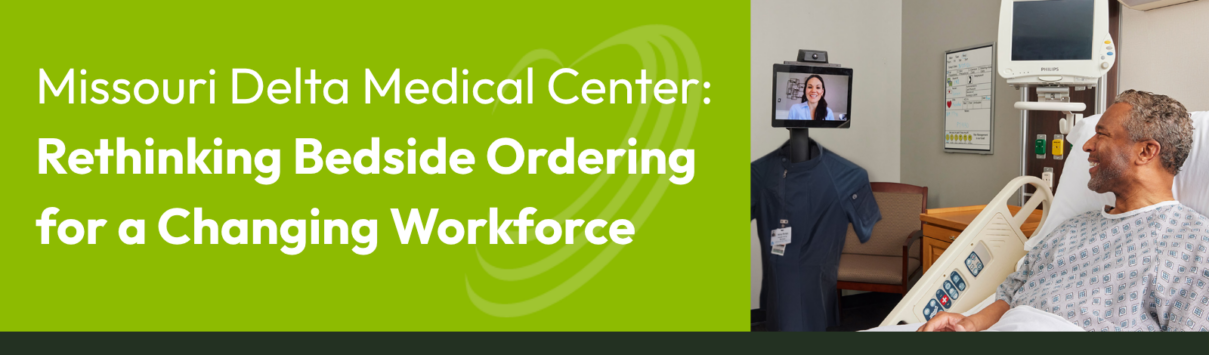
Rethinking Bedside Ordering for a Changing Workforce: Missouri Delta’s Remote Pilot
Missouri Delta Medical Center and Morrison Healthcare tested remote bedside meal ordering through “Molly MoMo,” a mobile telepresence robot operated by a remote Patient Dining Associate.
Within the first 60 days of the 90-day pilot, the team completed more than 1,500 patient meal orders and reported that approximately 100% of bedside orders were completed through the mobile model. A tracked measure covering non-select orders or patients whose orders were not taken declined from 14.44% to 11.05%.
The Opportunity: Expanding Staffing Options Without Losing Connection
Bedside meal ordering depends on timely, accurate conversations with patients. Missouri Delta and Morrison Healthcare used the pilot to explore a practical question: Could a qualified Patient Dining Associate work remotely while the hospital preserved the live, face-to-face interaction that makes bedside service personal?
The model was designed to expand the applicant pool beyond the immediate local market and allow onsite associates to concentrate on meal assembly and service. The objective was greater operational flexibility without removing human interaction from patient dining.
The Solution: A 90-Day Mobile Bedside Ordering Pilot
Morrison Healthcare launched the pilot with Missouri Delta using Molly MoMo, a mobile telepresence robot operated remotely by a Patient Dining Associate. Through live video, the associate could speak directly with patients and support meal-ordering workflows while onsite team members focused on preparing and serving meals.
The approach was designed to:
-
- Expand the applicant pool through remote work.
- Allow onsite associates to focus on meal assembly and service.
- Maintain live, face-to-face conversations with patients.
- Support accurate meal ordering within a more flexible staffing model.
Implementation: Building Familiarity Before Full Use
The team introduced the program through leadership demonstrations, staff education, patient communications and onsite support during the initial rollout. These steps helped patients and caregivers understand what to expect while giving associates support as they adjusted to the workflow.
According to the source document, early skepticism eased as patients and Patient Dining Associates became familiar with the model. The technology functioned as another channel for authentic conversation rather than a substitute for it.
Early Results: Operational Signals From the First 60 Days
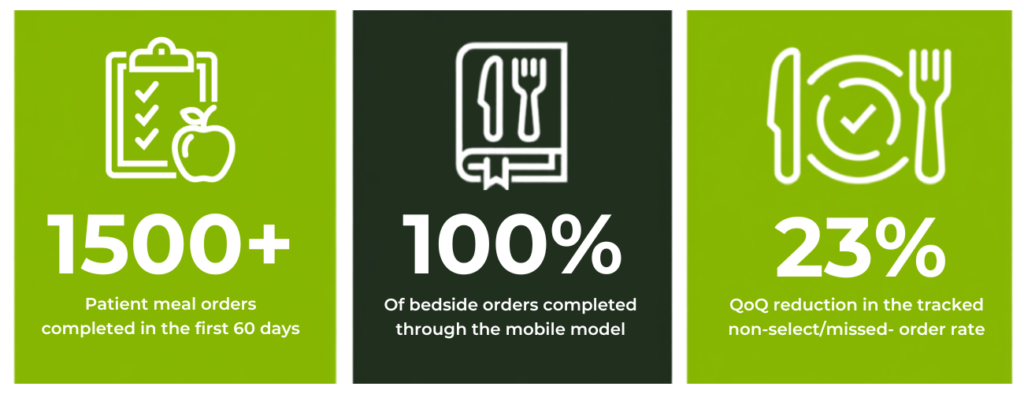
The tracked rate for non-select orders or patients whose orders were not taken declined from 14.44% to 11.05%. That represents a 3.39-percentage-point reduction and a 23% relative quarter-over-quarter improvement.
Additional early results included:
-
- More than 1,500 patient meal orders completed.
- Approximately 100% of bedside orders completed through the mobile ordering model.
- An average interaction reported as three minutes for three orders taken.
- Greater confidence in order accuracy, with fewer reports of patients receiving incorrect meals.
- Better completion of meal-ordering workflows and fewer missed meal selections.
- Positive patient and staff reception, countering early concerns that virtual interactions would feel impersonal.
Together, these results indicate operational feasibility and patient acceptance during the reported period. They should be understood as early pilot findings rather than controlled evidence of long-term or systemwide impact.
Why It Matters: A Flexible Model for Smaller Hospitals
The potential value extends beyond the robot itself. A remote Patient Dining Associate model can give hospitals access to qualified candidates outside the immediate labor market while allowing onsite teams to remain focused on physical, patient-facing responsibilities.
For smaller hospitals, this model offers a possible way to address workforce constraints without automatically trading away personal connection. Missouri Delta’s experience suggests that a virtual interaction can remain live, direct and human when implementation includes clear communication, education and onsite support.
This pilot also reflects Morrison Healthcare’s broader practice of customizing patient dining workflows and service interactions around each facility’s operational needs, as described in its Patient Experience services.
As Morrison Healthcare continues evaluating the pilot, the lessons are informing future approaches to predictive labor planning, remote workforce strategies and patient dining operations. Longer-term validation will be important before extending the early findings to other facilities.
Learn More
Explore Morrison Healthcare’s Patient Experience and MyDining resources for additional information about patient meal-ordering workflows, operational data and personalized service.