
Emergency Department Food Programs Improve Patient Experience, Nursing Workflow, and Cost Efficiency
Meeting a critical need during the Emergency Department admission experience
As Emergency Departments continue to experience rising volumes and increasing patient acuity, they have become a critical entry point into the inpatient setting. Patients admitted through the ED often face extended wait times, delayed meal access, and heightened physical and emotional stress during the transition to inpatient care. In this environment, meeting basic patient needs—particularly access to timely, high-quality food—can significantly influence both patient comfort and overall perception of care.



The Opportunity: Improving Emergency Department Operations Through After-Hours Meal Service
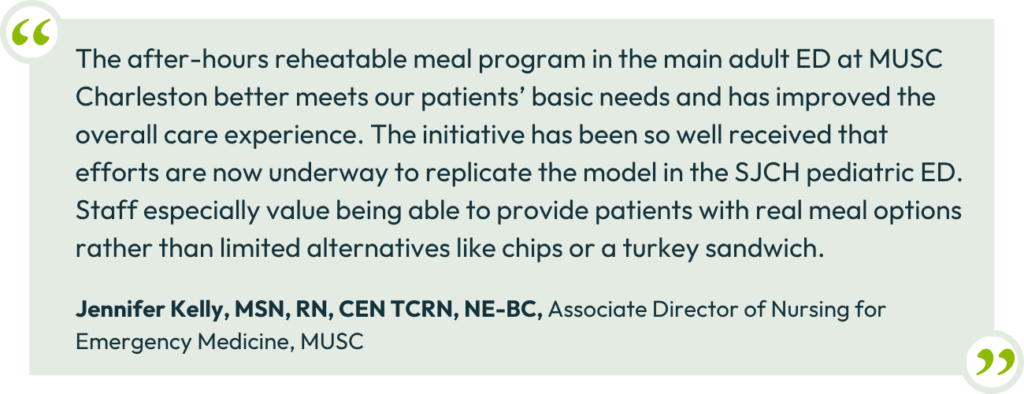
Traditional after-hours food options in many Emergency Departments are limited, often consisting of snacks or cold boxed meals that do little to support patient satisfaction or reinforce a sense of dignity and care. The ED food program was designed to address this gap by providing accessible, reheatable meal options during hours when standard food-service operations may be unavailable.
Beyond nutrition alone, the program supports a broader patient-centered care strategy by improving the admission experience and reinforcing the hospital’s commitment to holistic care. As the data demonstrates, targeted food-service interventions during the ED admission process can meaningfully improve patient perception, particularly among ED-admitted inpatients—the population most directly affected by delays, throughput challenges, and after-hours care transitions.
Rising Emergency Department Demand Is Driven by Higher-Acuity Patients
Projected adult ED visits will increase approximately 5% over the next decade, driven primarily by emergent visits growing 8% while urgent visits remain relatively flat. The 2026 forecast maintains this overall trend, with a modest upward adjustment to emergent visit growth, resulting in a slightly more favorable overall outlook.
Recent utilization trends further reinforce that ED growth is increasingly concentrated among medically complex, higher-acuity patients, as emergent visits continue to outpace urgent visit growth. At the same time, the ED remains the primary gateway to inpatient care, with approximately 70% of hospital admissions now originating through the ED. Community hospitals are even more reliant on ED-driven admissions, with nearly 80% of inpatient admissions coming through the ED.
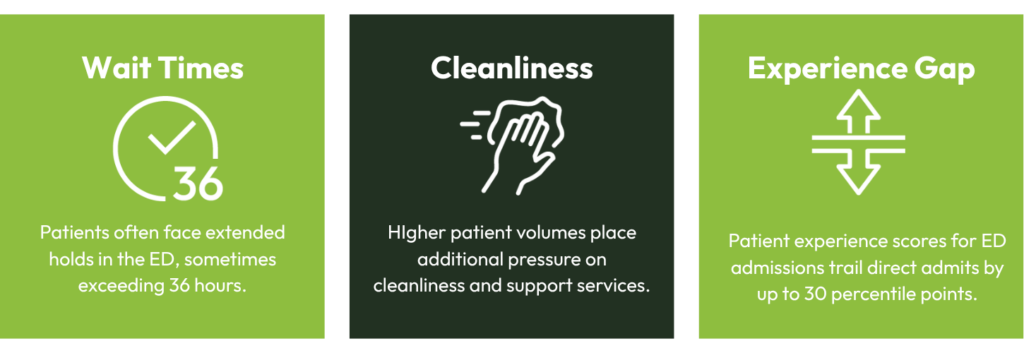
Key Operational Challenges Emergency Departments Continue to Face
Interpreting the Emergency Department Pilot Patient Experience Results
To evaluate the impact of the ED Pilot on food-related patient experience, key patient satisfaction measures—including Food Quality, Food Temperature, Courtesy, and Availability of Food the Child Likes—were analyzed using mean scores, top-box performance, and percentile rank. Overall hospital experience metrics were also incorporated to normalize performance across sites and provide broader context for interpretation.
A central measure used throughout the analysis is Rank Differential, defined as the difference between the percentile rank of a food-related metric and the overall “Rate the Hospital 0–10” metric. This approach helps determine whether food-service performance is improving relative to overall hospital experience, rather than in
isolation. Because it best captures meaningful directional change, Rank Differential was identified as the primary indicator for interpreting pilot impact.
Analysis further identified the ED-Admitted Inpatient population as the most operationally and analytically significant subgroup, given the direct influence of the ED experience on inpatient perception and throughput. Results from this cohort showed the clearest evidence of positive impact following implementation.
Overall, findings from the seven pilot sites indicate a largely positive effect on food-related patient experience. Approximately 86% of sites demonstrated either positive or mixed outcomes, and sites were four times more likely to improve than decline after implementation. The strongest and most consistent gains were observed specifically among ED-admitted inpatients, reinforcing that targeted foodservice interventions during the ED admission process can meaningfully improve patient perception and experience.
MUSC Charleston: Improving Patient Experience Through Targeted ED Meal Service
Results from MUSC Charleston further reinforce the importance of isolating the ED-admitted inpatient population when evaluating food-service impact. While broader inpatient trends demonstrated more modest movement, patients admitted through the ED showed substantially stronger gains in food related experience metrics.
For the Quality of Food measure among ED-admitted inpatients:
- Mean Rank improved by +27 points (21 → 48)
- Mean Score increased by +3.6 points (70.5 → 74.1)
- Rank Differential improved by +30 points (-27 → +3)
These findings suggest that targeted interventions introduced during the ED admission process had a measurable influence on patient perception, particularly when compared against overall hospital experience performance. Notably, the ED cohort outperformed the broader inpatient cohort on Quality of Food Rank Differential, reinforcing the value of evaluating ED-specific populations separately rather than relying solely on aggregate inpatient results.
The Charleston findings also support the broader operational connection between Food & Nutrition Services (FNS) and Environmental Services (EVS), as highlighted in Vizient and ANA guidance emphasizing that non-clinical support services play a critical role in shaping patient perception, throughput, and overall care experience. Improvements in food quality perception among ED-admitted patients suggest that operational touchpoints occurring early in the admission journey can meaningfully influence how patients evaluate the hospital experience as a whole.
MUSC Lancaster: Positive Trends Among Emergency Department-Admitted Patients
Evidence-based assessment: Mixed, but directionally positive for the ED cohort.
Results from MUSC Lancaster present a more nuanced picture, with overall inpatient performance showing variability while the ED-admitted cohort demonstrated comparatively stronger outcomes.
For Quality of Food, overall inpatient rank remained relatively stable, while Rank Differential declined modestly but remained positive. Importantly, the ED-admitted cohort continued to outperform the broader inpatient population, including a Quality of Food Rank Differential that exceeded the inpatient cohort by 3 points. This suggests that the ED intervention may have provided a degree of insulation against broader inpatient performance softness.
For Courtesy, overall inpatient performance declined more notably; however, the EDadmitted cohort improved on both rank and mean score measures. Although data limitations—including early removal of the Courtesy question and incomplete ED categorization (~35%)—limit the strength of definitive conclusions, the directional trends remain favorable within the ED subgroup.
Overall, the Lancaster results indicate a mixed but mildly positive outcome, with the clearest value signal emerging within the EDadmitted inpatient population rather than the total inpatient population. The pattern suggests that where overall performance softened, ED patients either declined less or demonstrated improvement, supporting the broader hypothesis that targeted ED foodservice interventions can positively influence patient experience even amid broader organizational variability.
UPMC Children’s Hospital of Pittsburgh: Reducing Nursing Burden While Improving Patient Care
While patient experience outcomes remain a critical measure of success, the Children’s Hospital of Pittsburgh pilot also demonstrated meaningful operational improvements by addressing a key stakeholder group in the ED environment—nursing staff.
Prior to implementation, study findings showed that 71% of nurses were responsible for managing aspects of the patient meal process, creating additional workflow burden in an already demanding care environment.
Recognizing this challenge, nurse feedback was intentionally incorporated into the design of the ED food-service model. Input gathered before implementation directly informed process changes, ensuring the solution aligned with frontline operational needs.
As a result, post-implementation surveys demonstrated 100% nurse satisfaction with the new workflow, suggesting that the redesigned process successfully reduced friction while improving confidence in meal delivery and patient support. This finding is particularly significant given the critical role nurses play in shaping both patient experience and operational efficiency within the ED.
Several operational enhancements contributed to these outcomes:
- Introduced a combination of re-heatable and chilled meal options stocked directly in the ED pantry
- Added dedicated refrigeration capacity to support meal availability and inventory management
- Improved meal presentation by serving meals on 9-inch disposable plates with induction bases, replacing traditional Styrofoam packaging
- Established a dedicated ED meal loading zone, reducing average delivery times by approximately three minutes
- Reduced average meal costs from $3.70 to $2.06 per meal, representing a 44% cost reduction
- Integrated production requirements into existing operations, requiring only 10 hours per week within current workflows
Sustained Improvement in Nursing Satisfaction
The operational improvements implemented through the ED meal-service redesign are further reflected in nursing satisfaction outcomes. A key performance indicator for the contract is nursing unit satisfaction, measured through the quarterly ESS (Employee Satisfaction Survey) completed by each nursing unit director. Performance is evaluated using top-box scores (9 or 10), providing a consistent measure of nursing leadership satisfaction with Food & Nutrition Services support.
Prior to implementation, the ED consistently received satisfaction ratings of 6 or 7, indicating opportunities for improvement in meal-service support and workflow alignment. Following the introduction of the ED foodservice enhancements in early 2024, satisfaction scores increased dramatically, with the ED receiving 9s and 10s
in every survey cycle. Since last year, the department has maintained a consistent top-box score of 10, demonstrating sustained satisfaction with the new process.
These results provide strong evidence that the program not only improved patient access to meals but also addressed longstanding operational pain points for nursing staff. The sustained improvement in ESS performance reinforces the value of incorporating frontline feedback into program design and highlights the broader organizational benefits of the ED foodservice model.
The Children’s Hospital of Pittsburgh experience highlights an important dimension of ED food-service interventions: the value extends beyond patient satisfaction. By reducing nursing burden, improving operational efficiency, lowering costs, and delivering higher-quality meal options, the program demonstrates how thoughtfully designed food-service solutions can support both patient-centered care and frontline clinical teams. This aligns closely with broader evidence from Vizient and ANA research, which emphasizes that improving support-service workflows can positively influence staff engagement, care delivery, and the overall patient experience.