How Relay Helped Transform Piedmont Augusta’s Service Levels
The Opportunity: Improving the Timeliness of Patient Meal Delivery
Piedmont Augusta is an acute care hospital in Georgia. The Morrison Healthcare team inside Piedmont provides food and nutrition for roughly 400 patients at their bedsides. In the past, says Director Terri Murray, PDAs frequently arrived late to deliver trays to patients. This was a critical issue since meal timing impacted medication schedules. Weak communication–kitchen staff had to rely on floor phones to find missing PDAs–compounded the issue. “There was a lot of food getting delivered late and no way to track what went wrong or what went right,” Murray says. “The nursing staff was calling the kitchen a lot and looking for accountability. It was a problem.”
The Solution: Creating Real-Time Visibility Into Meal Delivery
Managers needed to rein in the late deliveries while managing staff shortages and coping with a growing patient census. They moved from a traditional staffing model (one PDA per floor) to a more dynamic one that could be adjusted based on actual daily staffing. That required combining units, restructuring floor assignments and renegotiating delivery times with nursing.
Because the new model depended heavily on visibility and strong communication, the team adopted Relay, the cloud platform for frontline teams. Suddenly, managers and kitchen staff had a fast, reliable way to reach PDAs and an accurate view of where deliveries were breaking down. Instead of relying on personal phones and self-reported paperwork, managers could use location and delivery metrics to diagnose issues and make improvements in real time. Some PDAs were initially hesitant about the new technology but Murray made the case that the increased accountability would benefit patients. After rollout, she was quick to recognize and reward those PDAs who consistently hit their marks, something that drove friendly competition and closer inspection of what goes into a timely delivery.
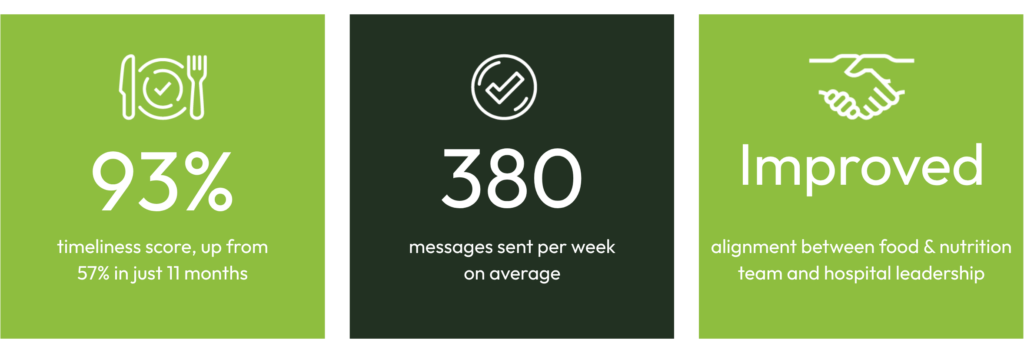
Relay seemed to drive an immediate spike in communication among PDAs, a welcome sign as the team onboarded new staff, says Operations Director Samuel Saxon. The team now uses Relay devices to send an average of 380 messages per week. More talk across devices means more clarity around diet changes and missing trays.
The Results: Turning Real-Time Data Into Measurable Improvement
The food and nutrition team is coming up on its one-year anniversary of using Relay. The technology’s impact has been transformative. Access to reliable real-time data has bolstered accountability and helped map and track locations to drive efficiencies. Timeliness–the team’s primary performance metric–has climbed from 57% to 93% in 11 months. Measurable improvement is top of mind for hospital leadership so this development has impressed and driven better overall alignment with management.
Data from Relay has helped the team constructively surface staffing issues. (At one point, a single PDA was tasked with serving 70 patients, Murray says.) On days when the team is short-staffed, the data reflects it immediately. “When we do have the proper staff,” says Operations Director Samuel Saxon, “you see excellent delivery numbers.” The clear cause and effect has helped the team make the case for more employees.
Having data on hand has also changed the dynamic between food services and nursing. When complaints arise—a late cart, a missed floor—the team can now respond with facts and insights rather than just apologies. Still striving for improvement, the team at Piedmont Augusta now routinely projects higher monthly average timeliness rates as they reach higher staffing levels.
Murray urges other Morrison sites to use Relay to its full potential and to look at location data as a way to unlock improvements to the patient experience. “When you ask someone to use a Relay,” she says, “it’s about making sure that they are on time for that patient.”